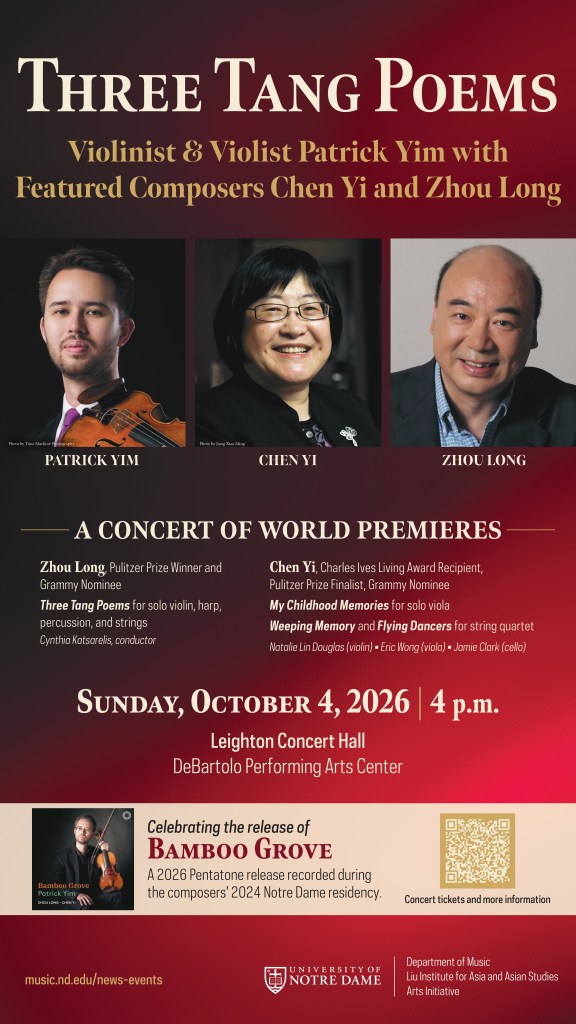
Three Tang Poems: Violinist Patrick Yim with Composers Chen Yi & Zhou Long at Notre Dame presents a concert of world premieres and contemporary music inspired by Chinese poetry, memories, and visual art. Featuring Zhou Long, Pulitzer Prize winner and Grammy nominee, and Chen Yi, Pulitzer finalist and Grammy nominee, the program includes the world premiere of Zhou’s Three Tang Poems, a violin concerto written for Patrick Yim, and the premiere of Chen’s My Childhood Memories, adapted for Yim. The concert follows the release of Yim’s new album Bamboo Grove (Pentatone, 2026), featuring world-premiere recordings created in collaboration with the composers during their 2024 residency at Notre Dame. Rooted in Chinese folk, philosophical, and spiritual traditions while engaging contemporary Western musical language, the music of Chen Yi and Zhou Long embodies a distinctive transcultural aesthetic that reimagines the expressive possibilities of modern instruments and ensembles. Moving beyond older paradigms of exoticism and cultural otherness, the concert fosters creative dialogue, mutual exchange, and a shared artistic space where Chinese and Western traditions meet while maintaining their distinct voices.
Program Notes:
Zhou Long: Three Tang Poems for solo violin, harp, percussion, and strings (2026)
ZHOU LONG born 1953, in Beijing, China Three Tang Poems, for solo violin, harp, percussion and strings (2026) 23′
“Three Tang Poems” — for Solo Violin, Harp, Percussion and Strings; Commissioned by the University of Notre Dame for Patrick Yim. Premiered on October 4, 2026, at Leighton Concert Hall, featuring Patrick Yim as violin soloist with the University of Notre Dame.
Scored for Solo Violin, Harp, Percussion and Strings (5-4-3-2-1) Percussion 1: glockenspiel, xylophone, peng ling bells, water cymbals, suspended cymbal (a chain on), Triangle, Mark-tree, piccolo block, wood block (5), bamboo chimes, bongos/congas. Percussion 2: vibraphone, marimba, peng ling bells, temple blocks (5), suspended cymbal (a chain on), 4 Opera gongs (7”-11” on foam pad), bowl chime wind gong, nipple gong (large), tam-tam, Chinese bass drum or bass drum.
“Three Tang Poems” consists of three movements inspired by the works of three poets of the Tang dynasty. This composition aims to conceptualize the violin and string orchestra as an expanded form of the guqin, borrowing various guqin fingerings and applying them to Western string instruments to capture both the delicate nuance and the majestic grandeur of ancient Tang poetry. Here, I have sought to directly fuse ancient Chinese and Western musical traditions, endowing the piece with musical qualities that immediately evoke the spirit of ancient China: sensitive melodies, expressive glissandi, and—above all—that subconscious sense of tranquility and contemplation characteristic of the traditional Chinese literati.
The first movement is based on the poem Hut Among the Bamboo by Wang Wei (701-761):
Sitting among bamboos alone,
I play my lute and croon carefree.
In the deep woods where I’m unknown,
Only the bring moon peeps at me.
The movement opens with muted string harmonics and the rustling of percussion, evoking a mysterious sense of space. In contrast, sweeping glissando clusters and cloud-like melodic figures alternate to create a dynamic tension—a sense of motion within stillness. Subsequently, with tremolo harmonics in the strings serving as a backdrop, the music draws to a close amidst the silence.
The second movement is based on the poem, Hearing the Monk Jun Play the Qin by Li Bai (701-762):
A monk from Shu with a green-silk-cased lute,
Down from the west at Emei Mountain peaks.
Playing for me with a wave of his hand,
Like listening to pines in ten thousand valleys.
The traveler’s heart is cleansed by flowing streams,
Lingering echoes join the frosty bells.
Unnoticed, dusk falls on the green mountains, Autumn clouds grow dark, layer upon layer.
The movement opens with the strings playing harmonic chords to simulate the sounds of the bells. Percussion instruments are used to suggest the echoing effect of sounds bouncing off the mountains and the lake. As if originating at different heights, the bell sounds rise in the trees. While the tremolo in the strings suggests the moaning of the wind in the pines, the varying pitch and dynamics of the percussion instruments create an effect of oscillating sound waves coming closer to and receding from the listener. The movement is in the form of a rondo and ends with the sounds seeming to dissolve into the distance.
The third movement is based on the poem Song of Eight Unruly Tipsy Poets by Du Fu (712-770). In this long poem, Du Fu provides individual humorous and affectionate descriptions of the drunken behavior of eight famous poets, all friends of his. He described the images of his drunk fellow poets as:
Unrestrained, undisciplined, humour and eloquent;
Riding on the horse, faltering steps in enjoyment;
Drawing on the paper, spattering inks as dancing dragon;
Howling toward the sky, citing poems feeling indignant.
The movement is in the form of a scherzo. I have written a rhythmic motive for the solo violin and a dialogue between the solo violin and the ensemble. The movement begins ad libitum, but as the poets’ drink increasingly, the tempo increases first to andantino and then to allegro, fast and wild at its climax, the point at which the poets are so uninhibited and “unruly.” The movement ends with eight identical fortissimo chords–one chord in honor of each poet. The chords are separated by eight measures of rest, during which we hear the faltering sounds of the strings, representing these by now very drunken poets, trying harder to continue reciting until eventually despite themselves they collapse into silence.
Chen Yi: My Childhood Memories for solo viola (2025/2026) [9’]
Commissioned by Nova Linea Musica for violinist Rabia Brooke, my solo violin suite My Childhood Memories consists of three movements: 1) Flying a Kite, 2) Throwing Sand Firecrackers, 3) Playing Sticking Plasters.
The three popular children games played in my childhood left such deep impression on me with love and memory that I wanted to reflect the scenes and my happiness in the violin solo suite. The kite flying high up in the sky is so peaceful and calm, which symbolizes freedom and confidence, and the connection between the earthly and the divine spiritually. I featured the crystal-like timbre in high register on the violin with serene melodies. As a contrast, I used the chord forms on the violin to imitate the round-shape small sand firecrackers sound when they were forcefully thrown on the land of the streets to make big noise during the lunar new year spring festival celebration. The last movement has intensive running passages mimicking the scene of the chasing game, Sticking Plasters: When children stand in a double circle, one child chases the other who should run and stick to the front of two standing children, while the child in the back row should start running and stick to the other front place. When a child is caught by the other, they should exchange roles. I had so much fun playing all these games together with my younger brother as a child when we grew up and wanted to enjoy the emotional memories eternally through my music.
The work was arranged for viola solo under the request of Prof. Patrick Yim who gave the world premiere of the new version at the University of Notre Dame in IN in 2026.
Chen Yi: From the Path of Beauty (2008)
FROM THE PATH OF BEAUTY is a seven-movement song cycle for mixed choir and string quartet. The first movement is for choir or vocal quartet, there are two movements for string quartet alone, and the other four movements are for choir with string quartet.
Commissioned by Chanticleer and the Shanghai Quartet for the celebration of their 30th and 25th anniversaries, the work was premiered on March 13, 2008 in San Francisco. The New York premiere followed on April 11, 2008 at The Metropolitan Museum of Art.
This composition is dedicated to Mr. Peter Henschel and Mr. Gordon Lau, honoring their great devotion and contribution to the friendship between the San Francisco Bay Area and China, with a high hope of improving the cultural understanding between our two countries and the peace of the world.
This four-movement string quartet version was co-commissioned by and premiered at the Freer Gallery o Art and Arthur M. Sackler Gallery, Smithsonian Institution, by the Shanghai Quartet in Washington, DC on April 23, 2008. The string quartet version uses four of the original seven movements in the revised order shown below:
I. The Bronze Taotie (originally I.)
II. The Rhymed Poems (originally IV.)
III. The Secluded Melody (originally VI.)
IV. The Dancing Ink (originally II.)
FROM THE PATH OF BEAUTY brings us through the history of beauty in Chinese arts, from ancient totems to figurines, from poetry to calligraphy, from dance to music, from thoughts to the spirit. It is deep in expression and rich in color, lyrical yet dramatic. The string quartet plays in non-traditional textures, such as the dark and dense blocks of moving chords with contrast of harmonic tones in the first movement (The Bronze Taotie, inspired by the bronze taotie from the Shang dynasty, c.1600-c.1100 B.C.), and the musical imitation of Chinese operatic reciting in the next movement (The Rhymed Poems, an instrumental realization of reading two poems by Li Qingzhao from the Song Dynasty, [960-1279] in Mandarin). The following movement (The Secluded Melody) is the polyphonic development of pitch material drawn from the qin (a 7-string ancient Chinese zither) music “Secluded Orchid in the Mode of Jie Shi” from the Six Dynasties period (497-590). In the last movement (The Dancing Ink), the strings have woodwind-like running passages, representing the exaggerated shapes and gestures in Chinese cursive from the Tang Dynasty (618-907).
The texts inspiring The Rhymed Poems follow:
As in a Dream, two poems by Li Qingzhao (Song Dynasty, 960-1279)
(English translation by Chen Yi)
I. I remember many times/We were in the sunset/At the pavilion by the rivulet,/Got drunk and lost our way
back./Returned by boat after thoroughly enjoying ourselves,/By mistake we went into the recesses of the
clusters of lotus./Paddled by bending to the oars,/Roused the gulls and egrets to flight/From the sand bars.
II. Last night fine rain, gusts of wind,/Deep sleep could not dissolve the leftover wine./I asked the person who was rolling up my curtains,/The answer was: “The begonias are still the same.”/“Don’t you know? Don’t you know it is time/For the green to flourish and the red to wither?”
Chen Yi Weeping Memory and Flying Dancers for string quartet (2024/2026)
Chen Yi’s Weeping Memory and Flying Dancers for string quartet is adapted from its saxophone ensemble version which was commissioned by the China Musical Instrument Association Saxophone (Electronic Wind Instrument) Art Professional Committee, and premiered at the 2025 World Saxophone Congress in Harbin, China. It’s premiered by Prof. Patrick Yim at the University of Notre Dame, IN in the U.S. in Oct. 2026.
In the first movement Weeping Memory, the human voice weeping sound is imitated by the instruments, which is supported by tragic chromatic short phrases, to express the composer’s mourning for the passing of a deeply respected friend; the second movement Flying Dancers is a sonic imagination of the gestures of the flying dancers which were carved in the Dunhuang cave on the Silkroad in Chinese history.

